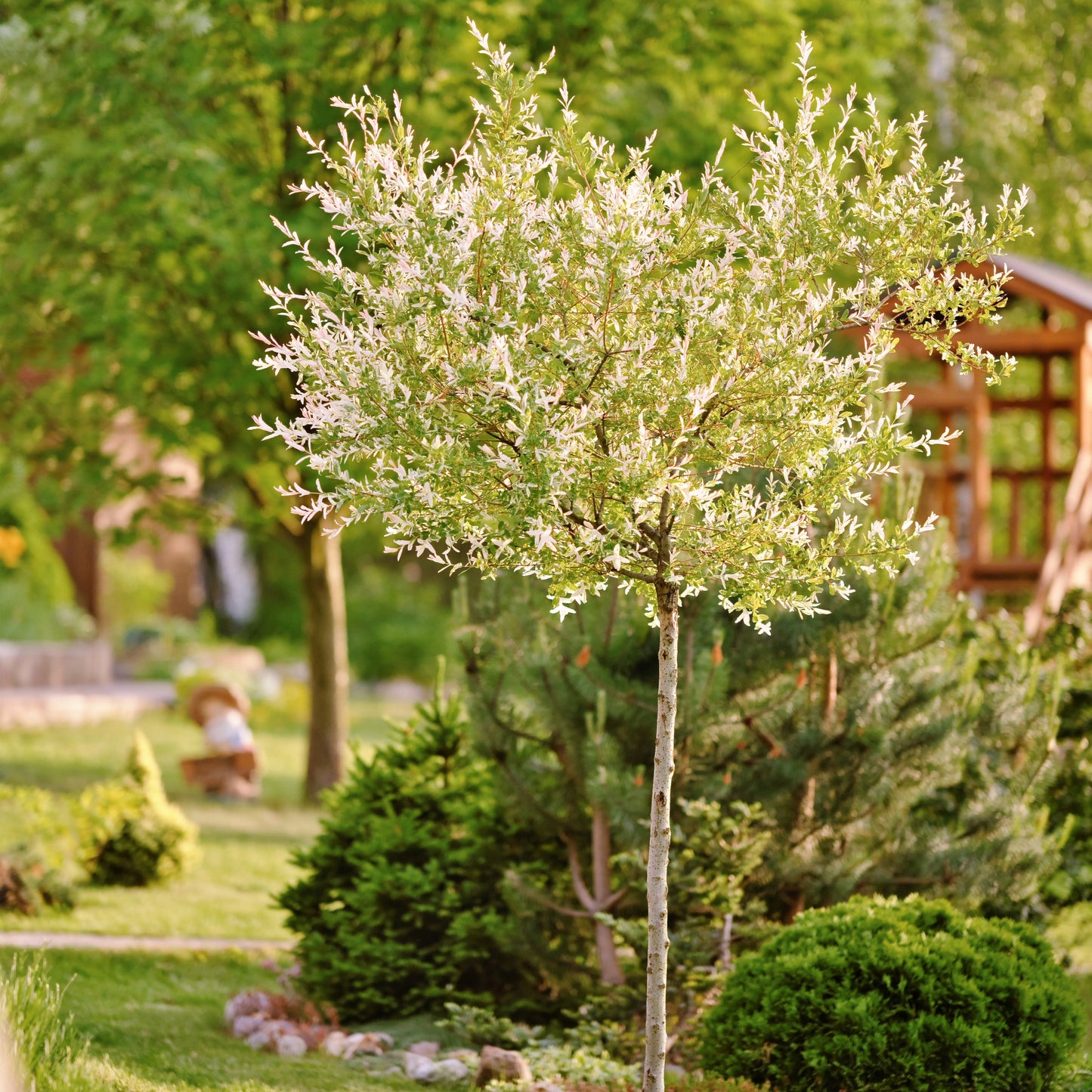
Add a splash of vibrant colour and dynamism to your garden with the Dappled Willow (Salix integra 'Hakuro-Nishiki')! Nicknamed the "Shrimp Willow" for its spectacular new growth in shades of pink and white, this unique shrub matures to variegated green and white foliage. Its reddish stems provide striking winter interest, making it a valuable asset for a vibrant garden in every season.
Characteristics
Foliage: Spectacular new spring growth emerges pink and white, then matures to variegated shades of pink, creamy white, and green. Narrow, lance-shaped leaves (up to 4 inches long) are particularly attractive in spring to early summer but gradually fade to mostly green as summer progresses. Foliage is deciduous (falls in winter).
Flowering: Produces non-showy, yellowish catkins (up to 1 inch long) in spring (April-May). The primary interest of this plant is its foliage.
Light Requirements: Tolerates full sun to partial shade. Full sun exposure generally promotes the best colouration of variegated new growth.
Habit: Forms a rounded shrub with arching, flexible branches.
Growth: Its growth is rapid. Reaches a mature height of approximately 120 to 150 cm (4 to 5 feet) and a spread of 90 to 120 cm (3 to 4 feet).
Humidity: Prefers moist soils and tolerates wet soils well. Requires medium watering.
Soil: Adapts well to most soils with good drainage, but prefers moist and rich soils.
Temperature: Very cold hardy. Tolerates winter cold well. New growth stems turn red in fall, providing excellent winter interest, especially in colder zones.
Watering: Medium to frequent watering, especially during dry periods. Ensure consistent soil moisture, but it also tolerates wet soils.
Resistances: Tolerates wet soils. Generally robust.
Usage
Types of Use: Ideal as a focal point in garden beds, as a small informal hedge, near water features, or in areas with moist soils. Also suitable for growing in large contenants.
Decorative Benefits: Its pink and white spring foliage is strikingly beautiful. The evolving variegation and reddish stems in winter (especially new growth) guarantee prolonged visual interest throughout the year. Its fine texture adds lightness to the landscape.
Maintenance
Fertilization: Fertilize in spring with a balanced fertilizer to promote healthy growth and good colouration.
Pruning: Pruning can be done in late fall (or early spring) by cutting back branches to 20-30 cm (8-12 inches) from the ground to encourage new, colourful growth in spring. Dead or dry branches can be removed at any time.
Planting:
Spacing: Space plants approximately 90 to 120 cm (3 to 4 feet) apart to allow for good development.
Depth: Plant at the same depth as it was in its container.
Period: Spring or early fall are the best times for planting.
Having an exceptional garden is possible, even in the city! Discover our selection of trees and shrubs perfect for small lots, and transform your outdoor space into a green oasis.
Discover our complete guide to mastering shrub planting and care. Learn the best planting times, essential techniques, along with tips for watering, fertilizing, and managing common issues. Our practical advice...
In exterior design, shrubs represent furniture. They set the scene and set the tone for the flower bed. Shrubs constitute the living architectural elements of the landscaped garden. As proof,...
Le grand choix d’espèces fournit l’occasion de varier les formes, les feuillages, et de créer des floraisons successives, bref, de composer un jardin magnifique à longueur d’année. Pour toutes ces...