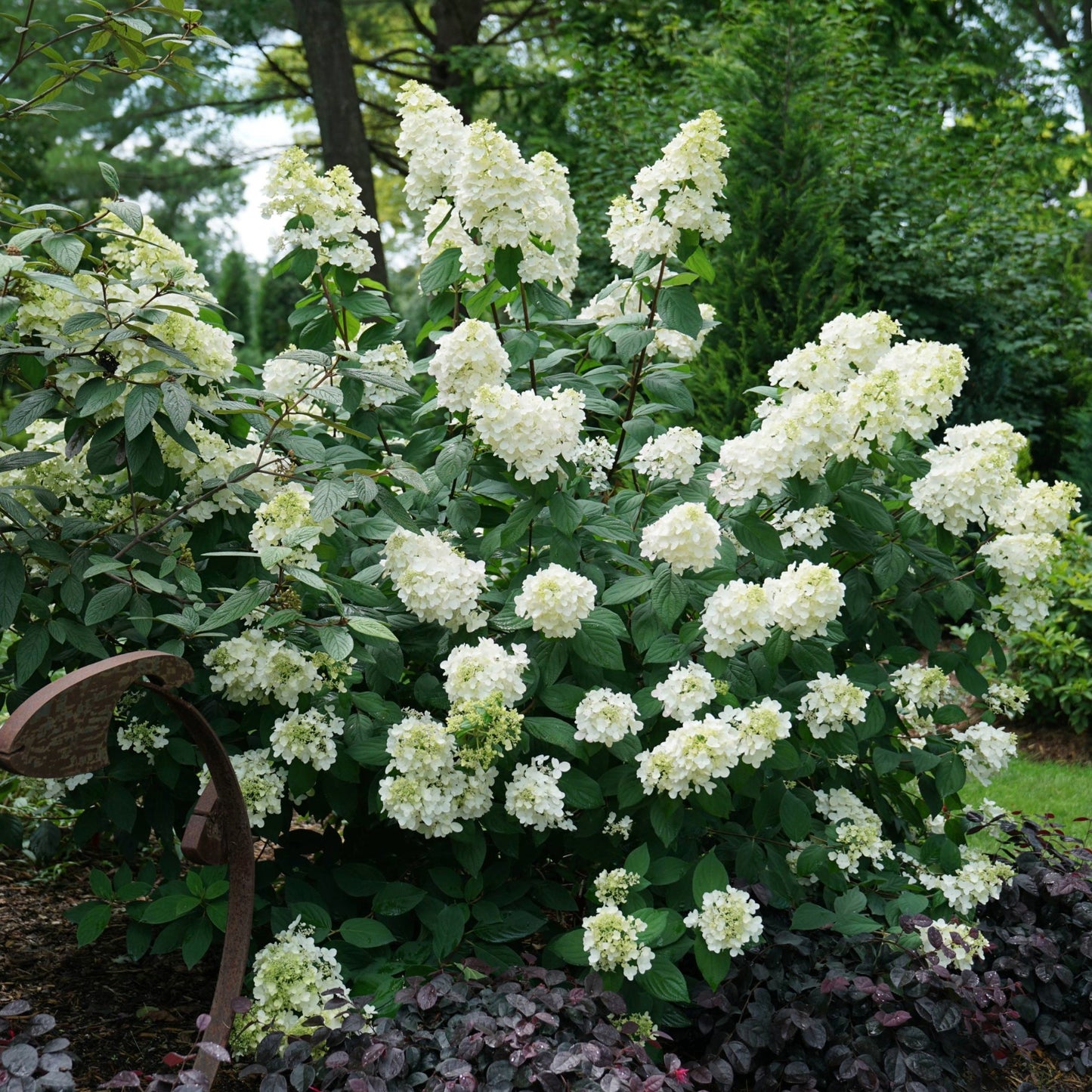
The Fire Light® Hydrangea sets the garden ablaze from summer to fall with a spectacular colour transformation. This sturdy, easy-care shrub starts the show in mid-summer with large, dense flower panicles of a creamy white. They quickly shift to a vibrant pink and then truly ignite with a rich, deep pomegranate-red as fall approaches. Held up on strong stems, these magnificent flowers stay upright and proud, offering a reliable, long-lasting display.
Characteristics
Foliage: Healthy and vigorous dark green foliage forms a perfect backdrop for the brilliant flowers. The foliage is deciduous.
Flowering: Blooms on new wood, ensuring reliable flowers every year. Large conical panicles (15-30 cm) emerge creamy white in July, colour to pink in August, and reach their deep red peak in September, a colour that lasts for several weeks.
Light: Prefers full sun for the most abundant blooms and intense colours, but tolerates part shade well.
Habit: Adopts an upright, rounded habit that is compact and well-proportioned.
Growth: Shows a moderate growth rate. Reaches a mature height and spread of about 180 to 240 cm (6-8 ft).
Soil: Adapts easily to most soil types but prefers well-drained soil. Flower colour is not affected by soil pH.
Temperature: Extremely hardy and perfectly suited for our climate, it performs exceptionally well even after harsh winters.
Resistance: Good resistance to White-tailed deer. Its thick, sturdy stems support the weight of the enormous flowers without bending, even after rain.
Use
Types of Use: Superb as a standalone specimen, in a mass planting for a striking effect, as an informal flowering hedge, or as a structural element at the back of a border.
Decorative Advantages: Offers an exceptionally long season of interest with its evolving blooms. The dried flowers persist on the shrub, adding texture and interest to the winter garden.
Care
Watering: Water regularly during the first season to encourage a strong root system. Once established, it tolerates short dry spells well.
Fertilization: Apply a slow-release fertilizer for shrubs in early spring, if needed.
Pruning: Prune the shrub back by one-third to one-half of its height in late winter or early spring. This encourages stronger stems and larger flowers.
Planting: Plant in spring or fall in a hole the same depth as the pot and twice as wide.
Winter Protection: No winter protection is required.
Having an exceptional garden is possible, even in the city! Discover our selection of trees and shrubs perfect for small lots, and transform your outdoor space into a green oasis.
Discover our complete guide to mastering shrub planting and care. Learn the best planting times, essential techniques, along with tips for watering, fertilizing, and managing common issues. Our practical advice...
In exterior design, shrubs represent furniture. They set the scene and set the tone for the flower bed. Shrubs constitute the living architectural elements of the landscaped garden. As proof,...
Le grand choix d’espèces fournit l’occasion de varier les formes, les feuillages, et de créer des floraisons successives, bref, de composer un jardin magnifique à longueur d’année. Pour toutes ces...