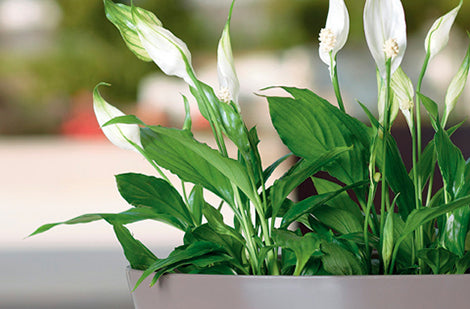
Anthurium andraeanum
Anthurium - Flamingo Lily / Painter's Palette
Exposure
- Indirect light
Rusticity
Bloom time
- January
- February
- March
- April
- May
- June
- July
- August
- September
- October
- November
- December
- Glossy, evergreen foliage.
- Spectacular long-lasting blooms.
- Natural air-purifying qualities.
- Moderate, rewarding maintenance.
- Timeless tropical-chic style.
The Anthurium is an essential indoor plant, prized for its colorful, waxy spathes that resemble natural plastic. Native to tropical regions, this plant adds a touch of exotic elegance and architectural structure to any living space, while remaining one of the world's longest-lasting cut flowers.
Characteristics
- Foliage: Dark green, heart-shaped, leathery, and highly glossy.
- Bloom: Waxy spathes (red, pink, or white) surrounding a central spadix. Blooms intermittently year-round under optimal conditions.
- Light: Prefers bright indirect light. Low light will reduce blooming, while direct sunlight will scorch the leaves.
- Habit & Growth: Upright and bushy habit. Moderate growth rate, reaching 45 to 60 cm (18-24 in) in height.
- Humidity: Prefers high ambient humidity. Enjoys regular misting or being placed near a humidifier.
- Soil: Requires rich but very porous and well-draining soil (indoor mix amended with bark or perlite).
- Temperature: Thrives between 18°C and 25°C. Sensitive to cold drafts and temperatures below 15°C.
- Watering: Let the top 2-3 cm of soil dry out between waterings. Never allow water to sit in the saucer.
Usage
- Tabletop Decor: Ideal as a focal point on a dining table or desk.
- Tropical Vibe: Perfect for adding color and texture to a collection of green plants.
- Health: Known for its air-purifying properties in living areas.
Maintenance
- Fertilization: Apply a phosphorus-rich fertilizer (such as 15-30-15) every two weeks from spring to fall to support blooming.
- Pruning: Trim faded flowers and yellowed leaves at the base with clean tools to encourage new growth.
- Repotting: Repot every 2 years in the spring into a slightly larger pot with drainage holes.
- Propagation: Easily propagated by dividing clumps during spring repotting.
Plant details
Dimensions
Dimensions
Characteristics
Characteristics
Habit:
- Upright
Flowering colours:
- Red
- White
- Green
- Purple
- Orange
Plant needs
Plant needs
Watering:
- Keep the potting soil slightly moist
Maintenance:
- Easy
Soil requirement:
- Rich
- well drained
Features
Features
Resistance:
Attract:
Use:
- Container
- Arrangement
Attribute:
- Successive flowering

Related articles
-
Potting House Plants: which pot to choose
Read the articleBien qu'une plante puisse passer plusieurs mois et parfois même plusieurs années dans le même pot, avec le temps ses racines envahissent tout l'espace disponible. Il devient important de choisir...
-
Moving Up a Level: Advanced Guide to Repotting ...
Read the articlePropagate your violets! Discover the simple cutting method, the secret to the perfect soil mix, and how to fight mealybugs.
-
The Complete Guide to Buying and Caring for Ind...
Read the articleBringing a touch of nature to your home with plants is a great idea! Not only do they beautify your living space, but they also help purify the air. However,...
-
Build Your Own Terrarium: The Complete, Easy Gu...
Read the articleThe terrarium is the perfect addition to your decor! Learn how to easily create your own miniature garden with our complete guide.
-
Create a garden with succulents
Read the articleLes plantes grasses n’ont pas leur pareil pour créer des arrangements à la fois impressionnants par leurs couleurs, leurs formes et leurs textures et faciles à entretenir. Qu’on les agence...
-
Houseplants to discover - Butterfly Palm or Are...
Read the articleDypsis lutescens, anciennement Chrysalidocarpus lutescens