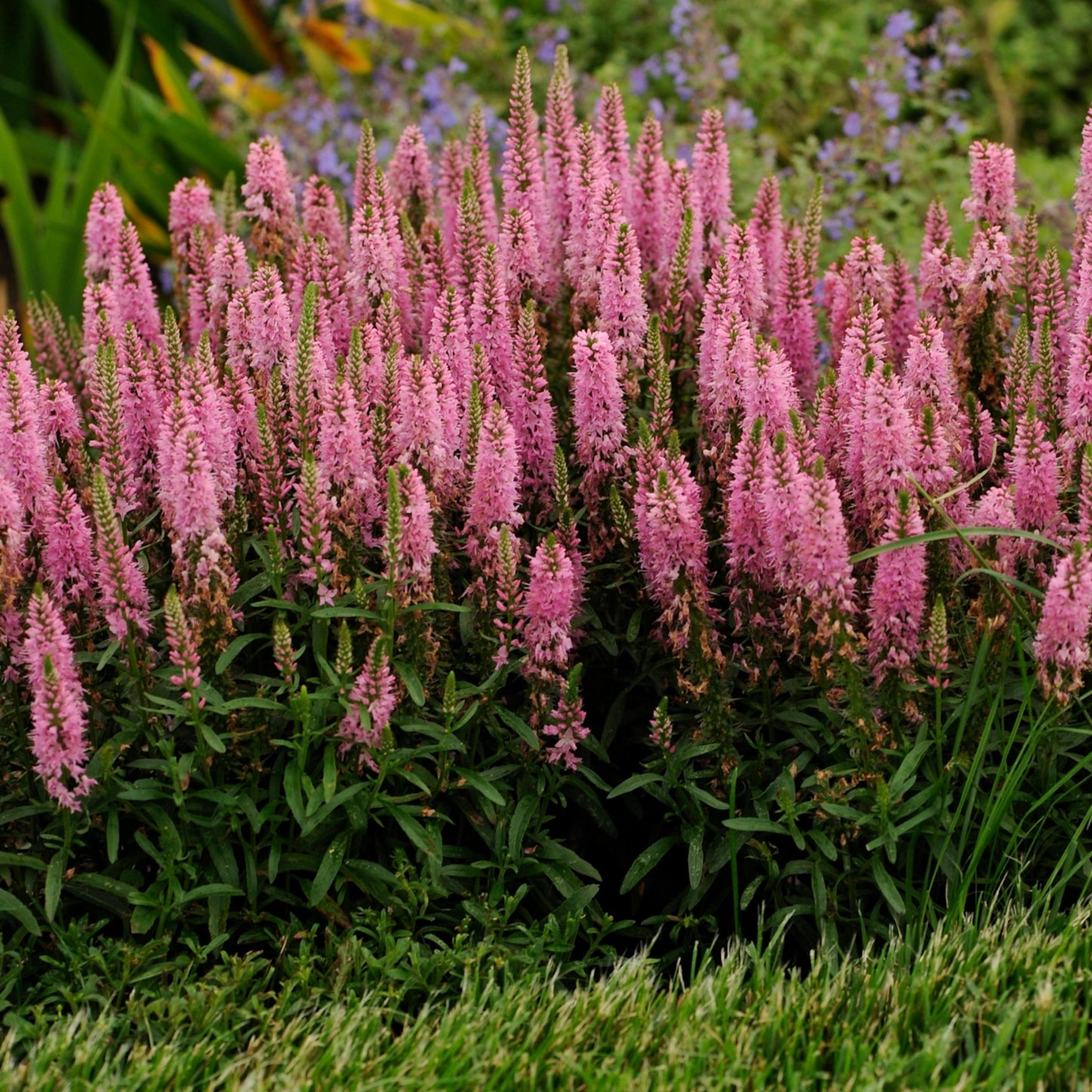
Brighten up your garden beds with this magnificent dwarf variety that deploys an abundance of slender, vibrant pink flower spikes. Giles Van Hees spike speedwell instantly energizes borders and rock gardens thanks to its compact silhouette and remarkably long-lasting bloom. It blankets the ground with a dense green carpet that beautifully showcases its colourful spires throughout the warm season.
Characteristics
Foliage: The deciduous leaves display a beautiful dark green hue. They form a low, dense, and upright clump, textured with finely toothed margins.
Flowering / Stems: Long, tight, vertical spikes stand proudly above the foliage. They carry countless tiny, luminous bubblegum-pink flowers.
Light: Provide a full sun location to maximize the intensity of its colour and the density of its blooms.
Habit: Bushy, compact, and upright.
Growth: This perennial grows at a moderate rate. It reaches a height of about 15 to 20 cm (6 to 8 inches) with a similar spread.
Soil: It thrives in loose, fertile, and especially well-drained soil. It dislikes stagnant excess water, particularly during the cold season.
Hardiness: It demonstrates excellent hardiness and easily tolerates zone 3.
Resistances: It effectively resists White-tailed deer as well as common diseases like powdery mildew when air circulates well.
Use
Types of use: Integrate it into the foreground of a flower bed, mass it to create a colourful border, place it at the heart of a rock garden, or plant it in a container on the patio.
Ornamental benefits: It brings a strong vertical structure despite its small size and creates a striking contrast of form alongside plants with wider or rounded foliage.
Maintenance
Watering : Water regularly after planting to promote deep root establishment. Once well established, maintain slightly moist soil but allow the surface to dry out between waterings.
Fertilization: Spread a layer of rich compost in spring or apply a balanced granular fertilizer at the very beginning of the growing season.
Pruning: Cut back flower spikes as soon as they fade to stimulate the appearance of fresh, colourful growth. Cut the dried foliage completely to the ground late in autumn or early in spring.
Planting: Space plants 20 to 30 cm (8 to 12 inches) apart to allow them to flourish fully while guaranteeing excellent air circulation.
Osez créer des associations inédites qui sauront refléter votre personnalité, même si pour cela vous deviez déplacer certaines vivaces pour mieux les mettre en valeur.
Variétés à découvrir, la tomate se savoure crue, en sandwich, en bruschetta ou en salade. Cuite, c'est l'ingrédient de base de sauces, soupes et salsas.
En pénétrant au jardin, ce sont souvent les plantes vivaces que l’on remarque en premier. Un massif de sauges, d’hémérocalles, d’astilbes, d’échinacées ou de lavande offre un spectacle d’une beauté...