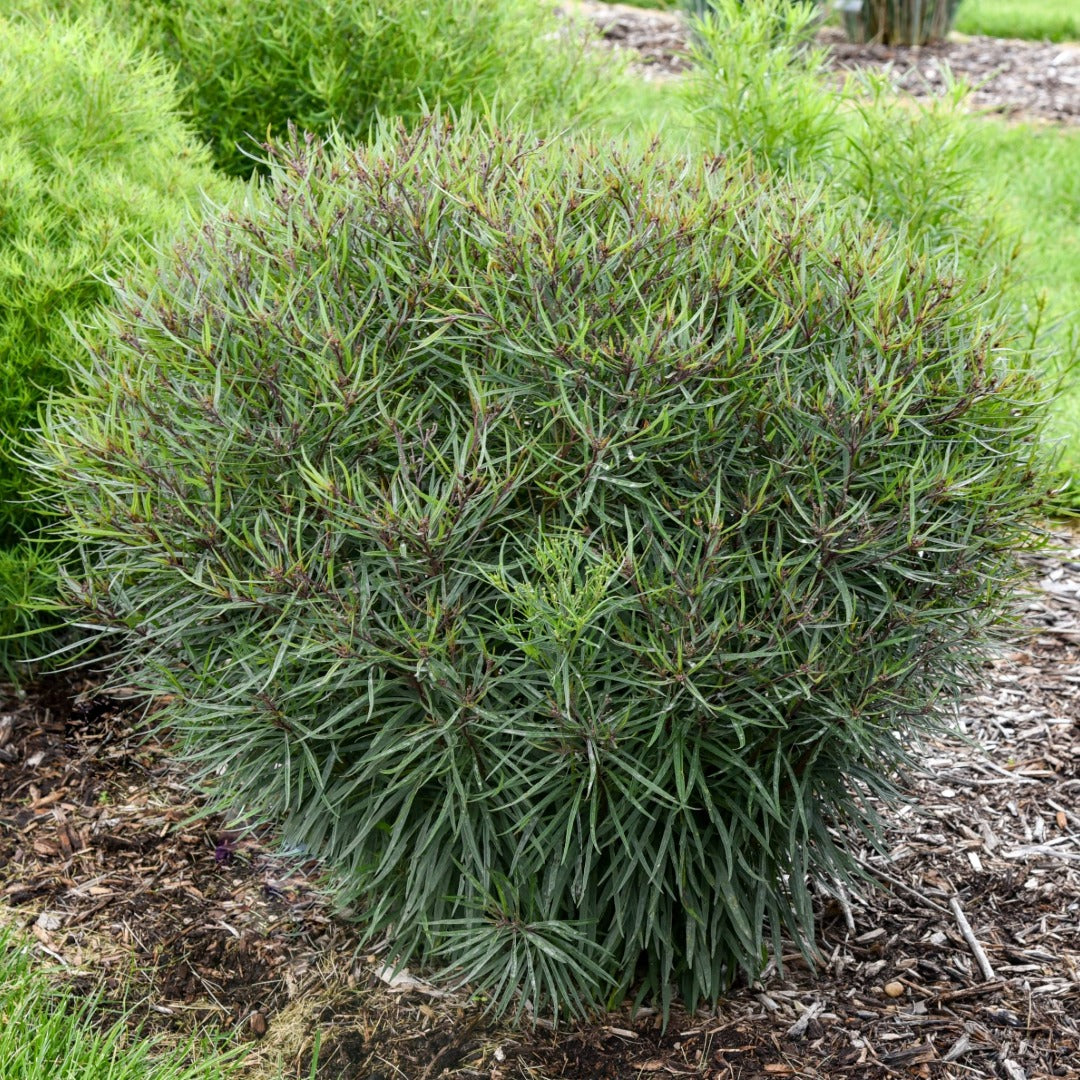
Prairie Princess ironweed energizes late-summer landscapes with vibrant clusters of rich violet-purple flowers. Its strong, sturdy stems support dense dark green foliage that remains attractive all season without staking. This hardy perennial draws waves of butterflies and pollinators just as other garden blooms begin to fade. It establishes reliable vertical structure in borders and rain gardens while thriving in moist soils and deterring white-tailed deer.
Characteristics
Foliage: Deciduous, lance-shaped dark green leaves maintain a crisp, clean appearance from spring through frost.
Flowering and stems: Fuzzy violet-purple flower heads crown sturdy, wind-resistant stems from late summer into autumn.
Light: Full sun ensures strong upright stems and maximizes flower production.
Habit: Upright, bushy silhouette brings architectural height and structure to back borders.
Growth: Fast-growing perennial reaching 90 to 120 cm in height without flopping.
Soil: Thrives in rich, loamy, moist to wet soils while adapting well to standard well-drained garden beds.
Temperature: Reliable cold hardiness in zone 4.
Resistances: Strong natural resistance to foliar diseases, white-tailed deer, and wet soil conditions.
Use
Plant in the back of mixed borders and perennial beds for late-season colour.
Naturalize along pond margins, rain gardens, and low-lying moist areas.
Cut flowering stems for long-lasting rustic indoor floral arrangements.
Maintenance
Watering: Water regularly to maintain consistent soil moisture, especially during summer dry spells.
Fertilization: Top-dress with rich organic compost or apply an all-purpose granular fertilizer in early spring.
Pruning: Cut stems back to ground level in late autumn or early spring before new growth emerges.
Plantation: Plant in spring or early autumn in loose, compost-enriched soil keeping the crown level with the soil line.
Osez créer des associations inédites qui sauront refléter votre personnalité, même si pour cela vous deviez déplacer certaines vivaces pour mieux les mettre en valeur.
Variétés à découvrir, la tomate se savoure crue, en sandwich, en bruschetta ou en salade. Cuite, c'est l'ingrédient de base de sauces, soupes et salsas.
En pénétrant au jardin, ce sont souvent les plantes vivaces que l’on remarque en premier. Un massif de sauges, d’hémérocalles, d’astilbes, d’échinacées ou de lavande offre un spectacle d’une beauté...