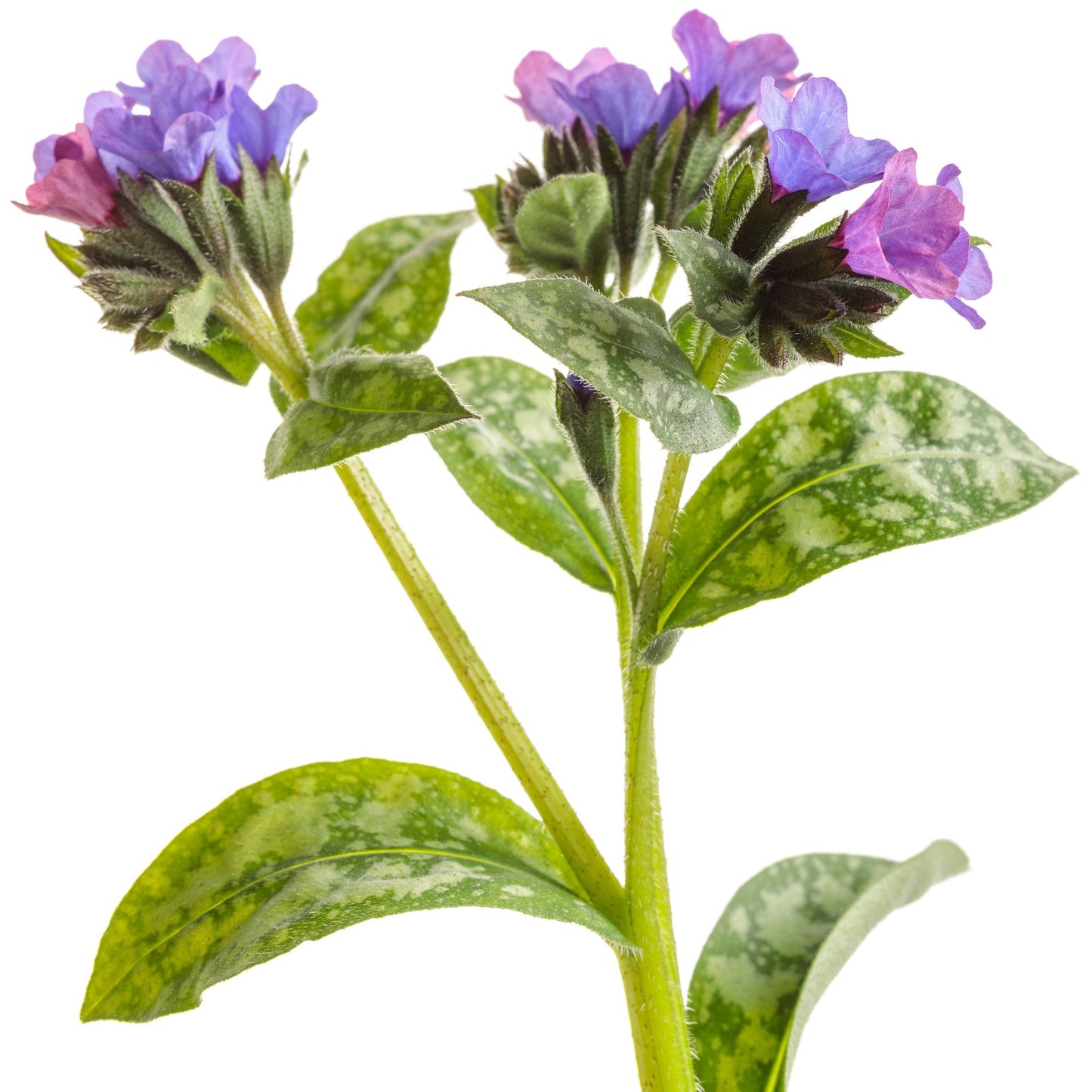
Brighten the shaded corners of your garden with 'Spot On' Lungwort, a spectacular variety that transforms the understory into a living masterpiece. Its large, deep green leaves are vigorously dappled with brilliant silver spots, maintaining their visual appeal long after the flowers fade. In early spring, it puts on a fascinating floral display: salmon-pink buds open to reveal rich cobalt-blue bells, creating a striking two-tone contrast against the luminous foliage.
Characteristics
Foliage: Large oval leaves, dark green, richly mottled with wide silver splashes. The foliage is deciduous but remains attractive from spring until the first frosts.
Flowering: Bell-shaped flowers transitioning from coral-pink to a deep, royal blue. Flowering is early and prolific.
Light: Prefers part shade to full shade. Avoid harsh afternoon sun.
Habit: Forms a compact, mounded, and well-defined clump.
Growth: Moderate growth rate, reaching approximately 30 to 40 cm in height.
Soil: Thrives in soil rich in organic matter that is cool and well-drained.
Temperature: Excellent Canadian hardiness, suitable down to Zone 3.
Resistances: Naturally resistant to powdery mildew and highly unappealing to deer and rabbits.
Use
Types of use: Ideal for border edges, mass planting under trees, or as a colourful groundcover. Performs exceptionally well in containers to brighten a shaded terrace.
Decorative advantages: Brings incredible luminosity to dark areas thanks to its silver foliage and provides one of the first sources of true blue in the spring.
Maintenance
Watering: Keep the soil consistently moist, especially during summer dry spells, as it does not tolerate bone-dry soil.
Fertilization: Apply rich compost or a balanced fertilizer in early spring to support new foliage growth.
Pruning: Remove spent flower stalks to maintain a tidy appearance. If foliage becomes less attractive after blooming, cut it back to stimulate the growth of fresh, healthy leaves.
Planting: Space plants 45 to 60 cm apart to ensure good air circulation.
Winter Protection: No specific protection required due to its high hardiness; however, an organic mulch is beneficial.
Osez créer des associations inédites qui sauront refléter votre personnalité, même si pour cela vous deviez déplacer certaines vivaces pour mieux les mettre en valeur.
Variétés à découvrir, la tomate se savoure crue, en sandwich, en bruschetta ou en salade. Cuite, c'est l'ingrédient de base de sauces, soupes et salsas.
En pénétrant au jardin, ce sont souvent les plantes vivaces que l’on remarque en premier. Un massif de sauges, d’hémérocalles, d’astilbes, d’échinacées ou de lavande offre un spectacle d’une beauté...