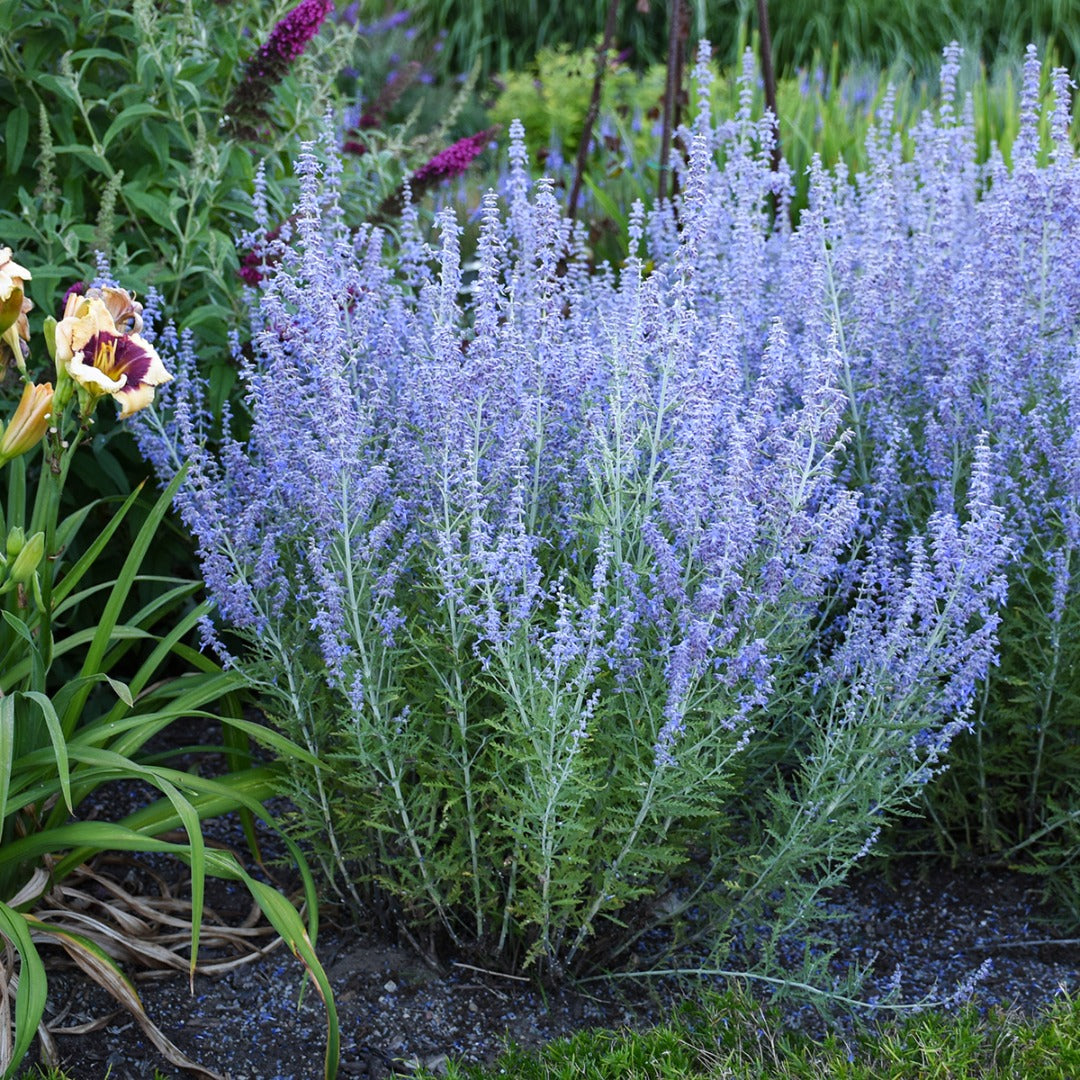
This compact variety redefines Russian Sage with exceptional vigor and an upright habit that never flops. Perovskia atriplicifolia 'Blue Jean Baby' immediately captivates with its early bloom, dressing the garden from midsummer onward. Its sturdy, silvery stems proudly hold dense spikes of intense lavender-blue flowers highlighted by smoky purple calyxes, creating a vibrant display that stretches beautifully into mid-autumn. The finely textured, aromatic gray-green foliage releases a pleasant fragrance whenever brushed against, structuring sunny landscapes with effortless elegance.
Characteristics
Foliage : Deciduous. The narrow, finely dissected, and aromatic leaves display a soft, elegant silvery gray-green hue.
Flowering / Fruiting / Stems : Solid, flop-resistant silver stems support dense panicles of lavender-blue flowers enclosed in rich purple calyxes. These colorful calyxes persist long after the flowers drop, extending visual interest well into autumn.
Light Requirements : Full sun. Maximum direct sunlight ensures a perfectly compact habit and intense coloration.
Habit : Upright, bushy, and compact, forming a dense and well-branched mound.
Growth : Fast. Quickly reaches its mature size.
Soil : Thrives in poor, sandy, rocky, and perfectly well-drained soils. Avoid heavy, clay, or constantly wet soils.
Temperature : Extremely hardy, tolerating harsh winters down to Zone 4.
Resistance : Shows remarkable tolerance to drought, intense heat, road salt, and urban pollution. Naturally deters White-tailed deer, hares, and rabbits due to its highly aromatic foliage.
Use
Types of use : Ideal for mass plantings, borders, perennial beds, or rock gardens to create waves of color. Perfect for container gardening on sunny patios. Makes excellent fresh-cut or dried flowers.
Decorative advantages : Adds a fine texture and an airy, lightweight feel to the landscape. The striking contrast between silver stems and violet-blue flowers beautifully enhances neighboring plants with yellow or pink blooms.
Maintenance
Watering : Water regularly during the first growing season to establish a deep root system. Once established, let the soil dry out completely between waterings, as this plant thrives in dry conditions.
Fertilization : Avoid over-fertilizing. Excessively rich soil causes weak, floppy growth instead of sturdy stems. A light top-dressing of compost in spring is more than enough.
Pruning : Cut the plant back hard close to the ground in early spring, just as new growth begins to appear, to encourage dense and vigorous branching.
Planting : Install in a hole twice as wide as the root ball. Space plants 75 to 90 cm apart to allow for optimal spread.
Osez créer des associations inédites qui sauront refléter votre personnalité, même si pour cela vous deviez déplacer certaines vivaces pour mieux les mettre en valeur.
Variétés à découvrir, la tomate se savoure crue, en sandwich, en bruschetta ou en salade. Cuite, c'est l'ingrédient de base de sauces, soupes et salsas.
En pénétrant au jardin, ce sont souvent les plantes vivaces que l’on remarque en premier. Un massif de sauges, d’hémérocalles, d’astilbes, d’échinacées ou de lavande offre un spectacle d’une beauté...