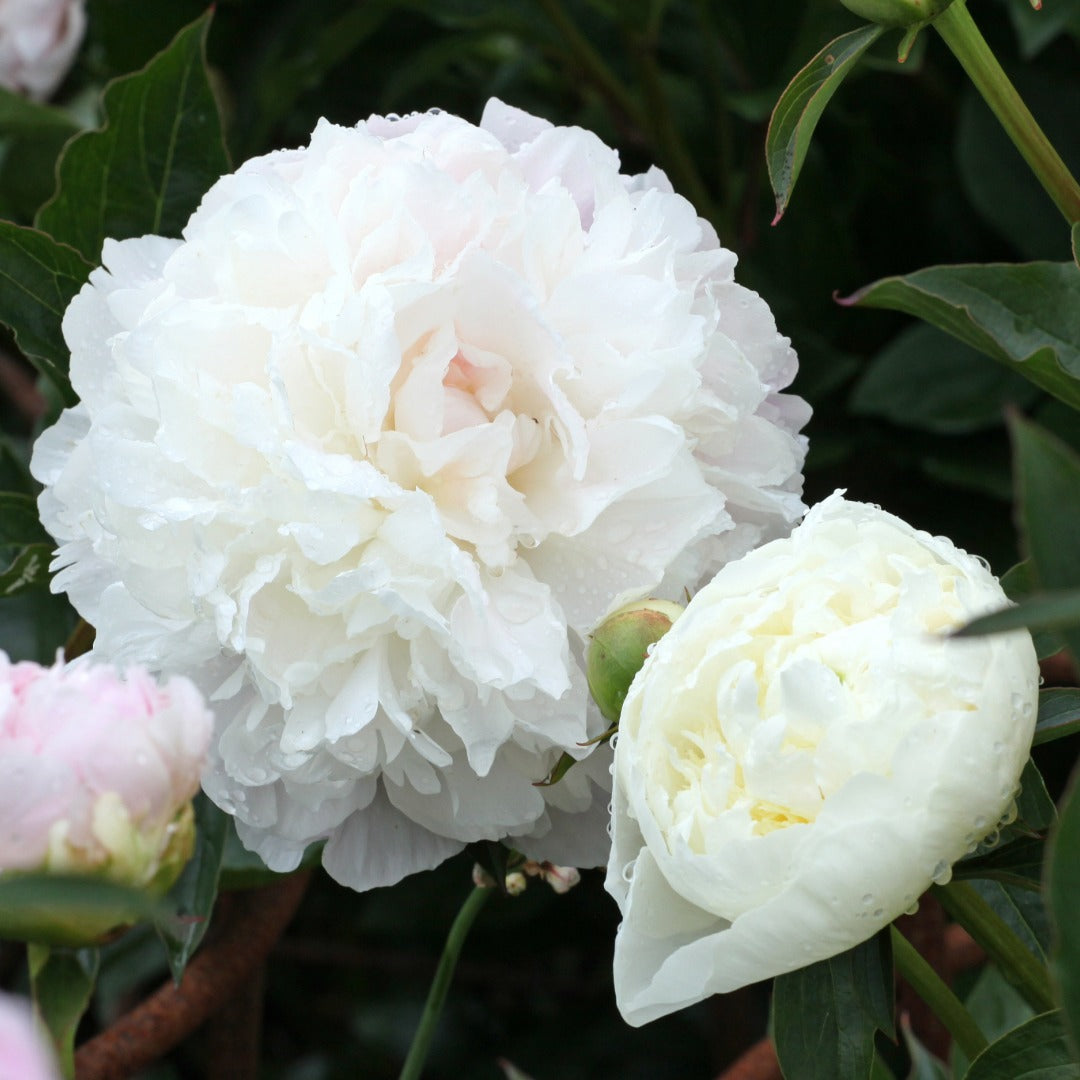
Illuminate your landscape with the timeless elegance of the 'Duchesse de Nemours' peony, a classic variety that has enchanted gardeners for over 150 years. Its large, creamy-white double blooms, enhanced by a soft sulfur-yellow glow at the base of the petals, release an intoxicating fragrance reminiscent of lily of the valley. This vigorous perennial displays its generous flowering atop deeply cut, dark green foliage, creating a striking contrast and a sturdy structure for your garden beds. It remains a must-have choice for bringing a touch of nobility and an unforgettable scent to outdoor spaces starting in early summer.
Characteristics
Foliage: Features deciduous, rich glossy green leaves that provide a bushy and healthy appearance throughout the entire season.
Flowering: Produces magnificent crown-shaped double flowers, creamy white with lemon-yellow tints at the base of the central petals in June.
Luminosity: Requires a full sun exposure to maximize the quantity of blooms, though it accepts partial shade.
Habit: Displays a proud, upright habit, forming a compact and well-structured clump.
Growth: Reaches a height of 90 cm and a spread of 75 cm with a moderate growth rate.
Soil: Thrives in rich, deep, and especially well-drained soil to avoid root rot.
Temperature: Shows exemplary hardiness suitable for zone 3.
Resistances: Effectively resists common fungal diseases and withstands intense cold.
Use
Types of use: Use this peony in perennial borders, along walkways, or as a focal point. It also performs very well in large containers.
Decorative advantages: Creates bright focal points thanks to its brilliant whiteness. It is one of the best varieties for crafting fragrant floral bouquets.
Maintenance
Watering: Maintain fresh soil, especially during bud formation and dry spells, without saturating the ground.
Fertilization: Fertilize with a phosphorus-rich fertilizer in early spring to stimulate abundant blooming.
Pruning: Remove spent flowers to maintain the plant's vigor. Cut all foliage back to the ground in late autumn after the first frosts.
Planting: Plant the roots so that the eyes are covered by no more than 2 to 5 cm of soil to ensure future flowering.
Winter Protection: Take advantage of its great hardiness, which requires no specific protection once the plant is established.
Osez créer des associations inédites qui sauront refléter votre personnalité, même si pour cela vous deviez déplacer certaines vivaces pour mieux les mettre en valeur.
Variétés à découvrir, la tomate se savoure crue, en sandwich, en bruschetta ou en salade. Cuite, c'est l'ingrédient de base de sauces, soupes et salsas.
En pénétrant au jardin, ce sont souvent les plantes vivaces que l’on remarque en premier. Un massif de sauges, d’hémérocalles, d’astilbes, d’échinacées ou de lavande offre un spectacle d’une beauté...