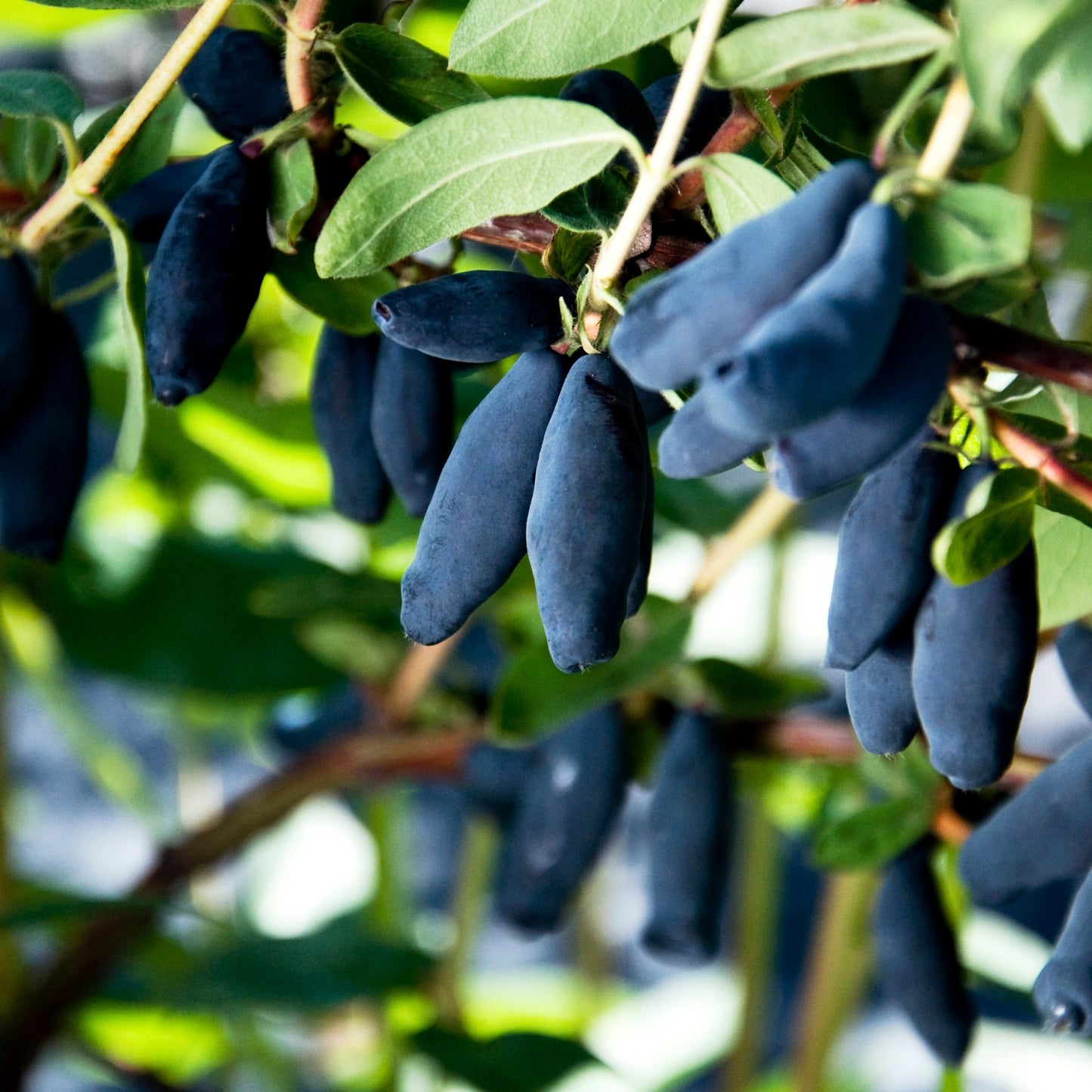
Lonicera caerulea 'Blue Banana'
Lonicera caerulea 'Blue Banana' - 'Blue Banana' Haskap (Honeyberry)
Lonicera caerulea 'Blue Banana' - 'Blue Banana' Haskap (Honeyberry)
Exposure
- Full Sun
- Partial Shade
Rusticity
Bloom time
- April - May
- Produces large, unique banana-shaped sweet berries.
- Offers an unusual, delicious smoked-strawberry flavour.
- Features rapid growth with a strong upright habit.
- Withstands extreme Canadian winter cold down to Zone 2.
- Ensures heavy yields from mid to late season.
Choose the 'Blue Banana' Honeyberry, a unique and captivating variety that reimagines the fruit garden with its banana-shaped berries and irresistible flavour! This vigorous shrub yields a profusion of very large, sweet fruits that are perfect for fresh picking. Boasting foolproof resilience against harsh climates and featuring rapid growth, 'Blue Banana' brings a touch of originality and abundance to your summer harvests.
The Harvest: Yield and Flavours
The 'Blue Banana' Honeyberry distinguishes itself through generous fruiting from mid to late season. Its original, long, and meaty berries are highly prized for their high sugar content and extraordinary aromatic profile.
- Harvest Period: Late June to mid-July
- Visual Description: Very large blue berries, elongated and slightly curved, evoking the shape of a banana. They display a deep blue-violet colour beneath a velvety bloom.
- Flavour Profile: Exceptionally mild and sweet. It unleashes complex and sought-after taste notes that recall an exquisite blend of smoked strawberry, raspberry, and blueberry.
- Culinary Uses: Ideal for eating fresh right off the bush. It also excels in creating original desserts, gourmet jams, pies, juices, or boosting your smoothies. Freezes beautifully.
Planting Guide
To ensure the success of your 'Blue Banana' honeyberry, follow these key steps:
- The Ideal Location: Plant your 'Blue Banana' in full sun to maximize photosynthesis and concentrate the sugars within the berries. Light partial shade is tolerated but will slightly reduce the overall yield. Choose a wide-open site.
- Soil Preparation: This cultivar thrives in loose, humus-rich, and well-drained soil. While adaptable to various soil types, it prefers a neutral to slightly acidic pH (6.0 to 7.0). Generously enrich your native soil with high-quality compost.
- Planting: Dig a hole twice as wide as the pot. Position the root ball so that the crown sits flush with the soil surface. Fill with your amended soil blend, then pack down gently to dispel air pockets. Space the plants 1.2 to 1.5 metres (4 to 5 feet) apart.
- Pollination:
- Type: Requires cross-pollination. 'Blue Banana' blooms a bit later in the spring and needs a compatible partner to ensure an abundant fruit set.
- Suggested Partners: Pair it with mid-season to late-blooming varieties. Cultivars such as 'Boreal Beast', 'Honey Gin', or 'Happy Giant' make excellent choices as pollination partners.
Care and Maintenance Guide
- Watering: Maintain a regular water supply to keep the soil uniformly cool, primarily during the planting year and throughout fruit development. Applying mulch helps stabilize soil moisture.
- Fertilization: Fertilize early in the spring with a natural fertilizer for small fruits or a surface application of well-rotted compost. This stimulates spring vigor and supports berry production.
- Pruning: Fast-growing with an upright habit, it requires very little initial intervention. After a few years, perform light thinning in late winter to remove old wood (over 5 years old) and promote the renewal of fruiting branches.
- Protection:
- Against Birds: The shape and colour of these large berries quickly attract feathered foodies. Deploy bird netting as soon as the fruit begins to change colour.
- Winter Care: Showing total hardiness down to Zone 2, 'Blue Banana' perfectly tolerates the harshest Canadian winters without any additional protection.
Plant details
Dimensions
Dimensions
Characteristics
Characteristics
Habit:
- Bushy
- Compact
Flowering colours:
- Cream
Plant needs
Plant needs
Watering:
- Regular (young plants)
- Drought Tolerant (established)
Maintenance:
- Easy
Soil requirement:
- Well-Drained
- Rich in Organic Matter
- Neutral to Slightly Acidic
Features
Features
Resistance:
- Cold
- Diseases
- Insects
Attract:
- Birds
- Butterflies
- Pollinators
- Bees
Use:
- Mass Planting
- Edible Garden
- Hedge
- Specimen
- Pots and Containers
Attribute:
- Edible Fruits
- Very Hardy
- Very Productive
- Large Berries
- Very Firm
- Sweet Flavour