The 'Velvet Moon' Plantain Lily truly lives up to its name: its large leaves offer a thick, almost velvety texture that illuminates the shade garden like a moonbeam. It is distinguished by a dark chartreuse green centre surrounded by an extraordinarily wide and brilliant golden-yellow border. This vigorous plant maintains its striking colour contrasts throughout the summer without ever fading.
Characteristics
Foliage: Very large heart-shaped leaves with an exceptionally wide golden-yellow margin encircling a lime-green centre.
Flowering / Fruit / Stems: Produces pale lavender bell-shaped flowers on sturdy scapes in mid-summer.
Light: Prefers partial shade to highlight the golden radiance.
Habit: Forms a large, dense, and commanding mound.
Growth: Reaches approximately 60 cm (24 inches) in height.
Soil: Thrives in humus-rich, moist, and well-drained soil.
Temperature: Very hardy (Zone 3).
Resistances: Excellent slug resistance thanks to the thickness of its leaves.
Use
Types of use: Ideal as a focal point, in perennial mass plantings, or to brighten a woodland area.
Decorative advantages: The width of its yellow border creates a massive and structured luminous effect.
Maintenance
Watering: Regular watering to keep the soil moist, especially during heat.
Fertilization: An application of compost or fertilizer in spring stimulates its vigour.
Pruning: Clean up dead leaves in early spring before new growth appears.
Planting: Provide generous spacing of at least 1 metre for full development.
Winter Protection: Extremely cold-hardy; organic mulch is sufficient.
Expert Note for Zone 2: In Zone 2, the growing season is short. Hostas will take longer to reach their mature size (typically 5 to 7 years instead of 3). The use of a thick organic mulch (10 cm) is crucial—not for cold protection, but to delay emergence in the spring. This prevents late frosts from burning the first emerging tips.
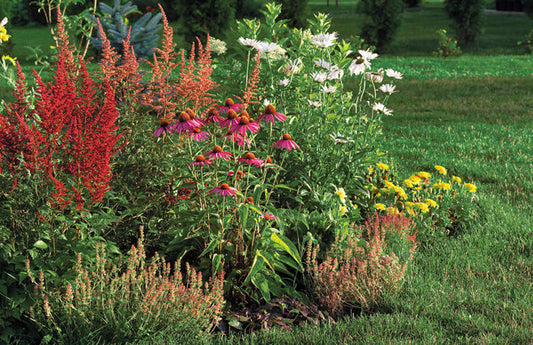
Osez créer des associations inédites qui sauront refléter votre personnalité, même si pour cela vous deviez déplacer certaines vivaces pour mieux les mettre en valeur.
Variétés à découvrir, la tomate se savoure crue, en sandwich, en bruschetta ou en salade. Cuite, c'est l'ingrédient de base de sauces, soupes et salsas.
En pénétrant au jardin, ce sont souvent les plantes vivaces que l’on remarque en premier. Un massif de sauges, d’hémérocalles, d’astilbes, d’échinacées ou de lavande offre un spectacle d’une beauté...