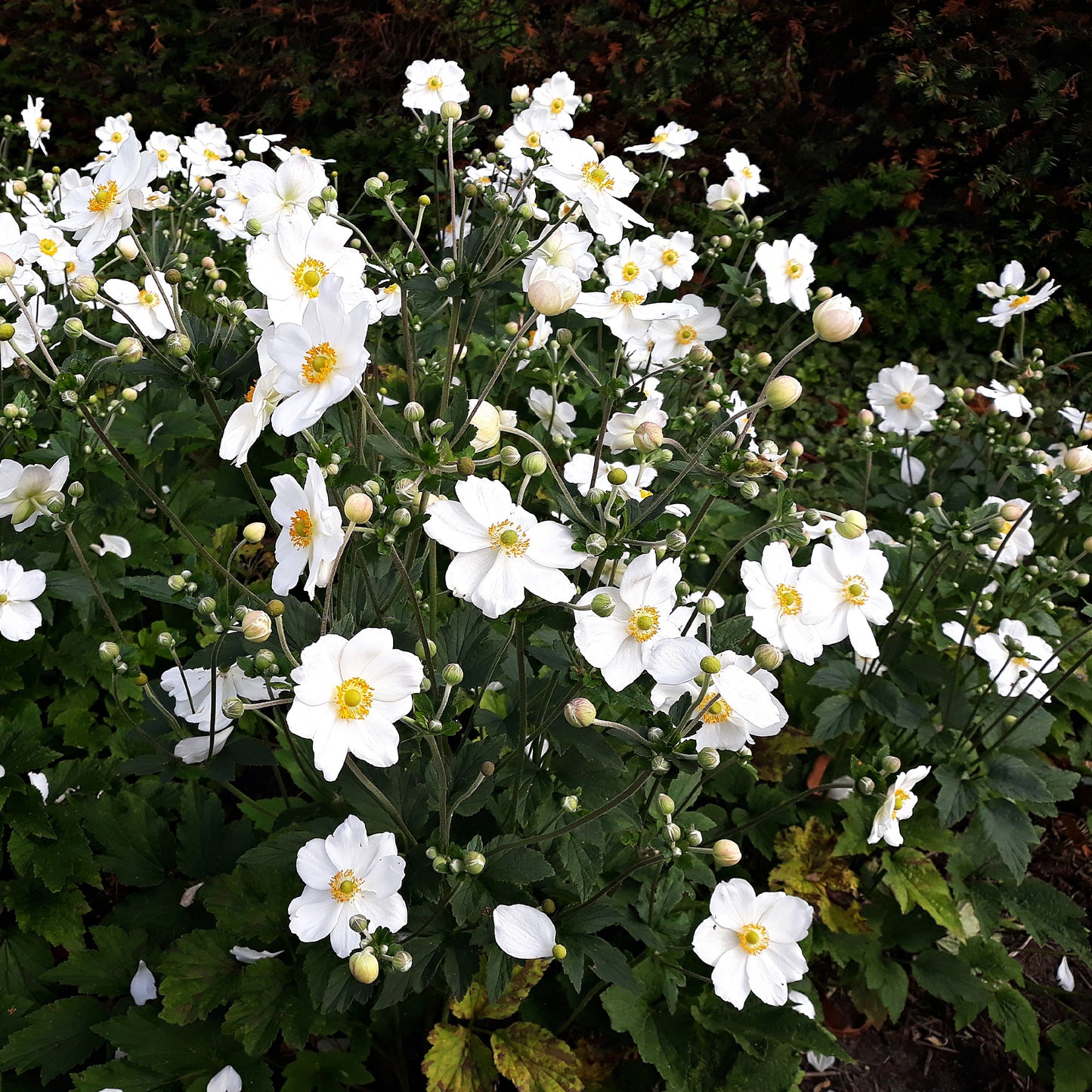
The 'Honorine Jobert' Anemone illuminates the fall garden with timeless elegance. Like a ballerina, it displays tall, slender stems that dance in the breeze, crowned with brilliant, pure white flowers. Each bloom, enhanced by a heart of golden stamens, seems to float above the dark foliage, bringing light and movement to flower beds as most other blooms are finishing. It is a classic and reliable perennial that adds an unparalleled touch of grace.
Characteristics
Foliage: An attractive mound of deeply cut, dark green foliage forms a dense base. The foliage is deciduous.
Flowering: From late summer into fall, magnificent single flowers, 5 to 8 cm in diameter, come into bloom. They feature immaculate pure white petals surrounding a prominent centre of bright yellow stamens.
Light: Thrives in part shade or morning sun. It can tolerate full sun if the soil remains consistently cool and moist.
Habit: Adopts an upright, airy habit, forming clumps that slowly spread by rhizomes to create beautiful colonies.
Growth: Sometimes slow to establish in the first year, it then shows a moderate growth rate. Reaches a height of 90 to 120 cm (36-48 in) when in flower and spreads to 45 to 60 cm (18-24 in).
Soil: Requires soil rich in organic matter that is well-drained yet retains constant moisture. Does not like dry soils or waterlogged conditions in winter.
Temperature: Quite hardy, but winter mulch is recommended in colder zones to protect the crown.
Resistance: Very resistant to White-tailed deer and rabbits. It has few problems with diseases or pests.
Use
Types of Use: Wonderful for the back of flower beds and borders, in mass plantings, in cottage-style gardens, or in light woodland gardens.
Decorative Advantages: Brings a touch of light and graceful verticality to late-season scenes. Its white flowers beautifully capture the twilight.
Care
Watering: Water regularly and deeply to keep the soil consistently cool, especially during dry periods.
Fertilization: Work compost into the soil each spring to maintain its richness.
Pruning: Leave the foliage in place during the winter to protect the crown. Cut back old stems and dead foliage in early spring.
Planting: Plant in the spring to allow for good root establishment before winter. Avoid moving it once it is established.
Winter Protection: Apply a thick layer of mulch (shredded leaves, straw) over the crown after the first hard frosts to protect it from freeze-thaw cycles.
Osez créer des associations inédites qui sauront refléter votre personnalité, même si pour cela vous deviez déplacer certaines vivaces pour mieux les mettre en valeur.
Variétés à découvrir, la tomate se savoure crue, en sandwich, en bruschetta ou en salade. Cuite, c'est l'ingrédient de base de sauces, soupes et salsas.
En pénétrant au jardin, ce sont souvent les plantes vivaces que l’on remarque en premier. Un massif de sauges, d’hémérocalles, d’astilbes, d’échinacées ou de lavande offre un spectacle d’une beauté...