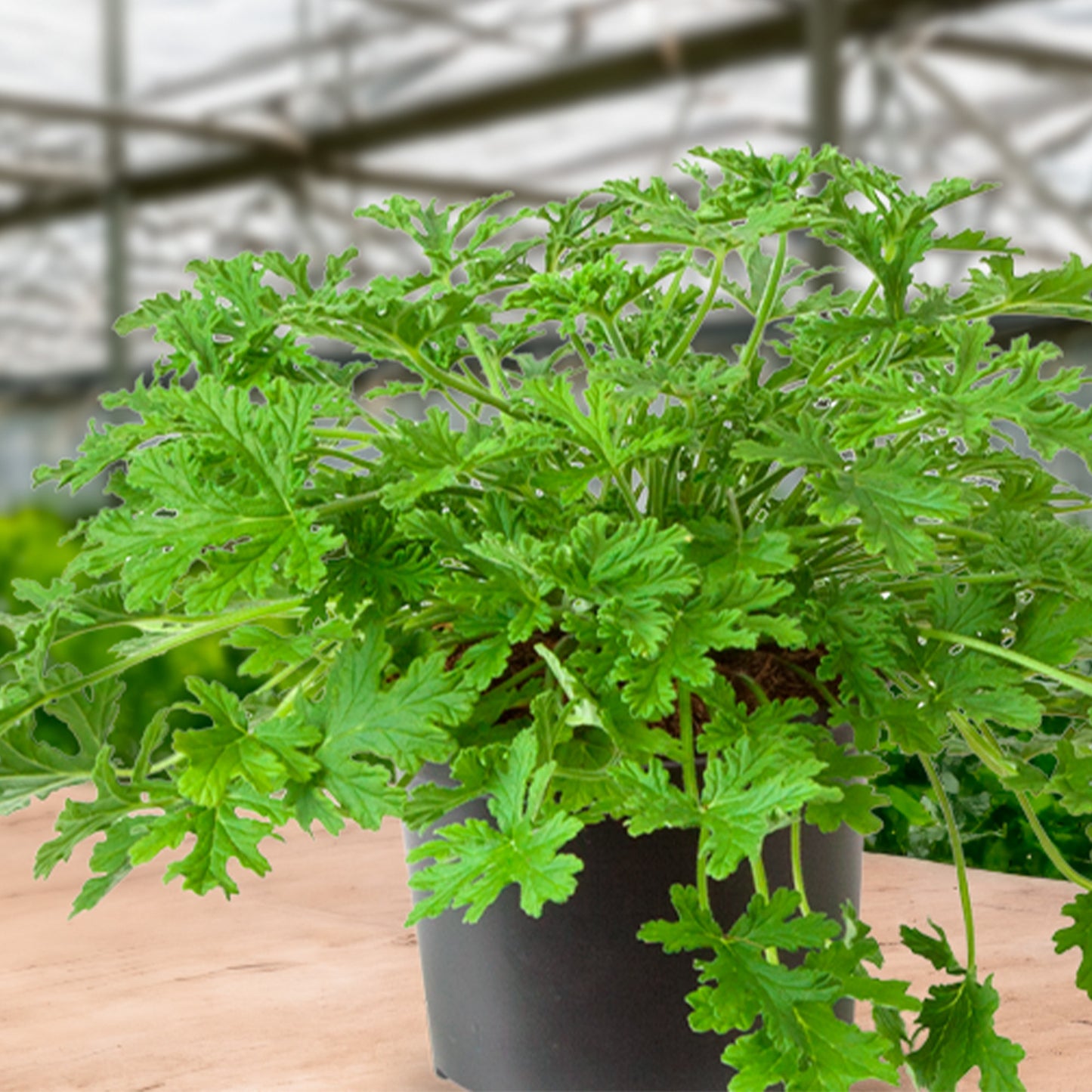
Pelargonium graveolens 'Citrosa'
Pelargonium graveolens 'Citrosa' - Citrosa Scented Geranium
Exposure
- Sun
- Part-sun
- Part-shade
Rusticity
Bloom time
- June
- July
- August
- September
- Potent lemon/citronella scent
- Reputed to repel mosquitoes
- Delicate, cut green foliage
- Ideal for pots and patios
- Easy to care for
Protect your summer evenings with Pelargonium graveolens 'Citrosa', often called the "Mosquito Plant"! This Citronella Geranium is famous for its delicately cut foliage that releases a powerful lemon and citronella scent when brushed or crushed. An attractive and functional addition to your balcony, patio, or garden, 'Citrosa' is the natural solution to deter mosquitoes while decorating your outdoor space.
Characteristics
- Foliage : The foliage is green, very deeply cut and toothed, with a delicate, lacy texture. Its main characteristic is the strong citronella scent it releases when touched or crushed. The foliage is evergreen in warm climates, but deciduous with frost.
- Bloom : Produces small, inconspicuous flowers, generally pale pinkish-lavender in colour, appearing in summer. Flowering is often insignificant and not the plant's main attraction, as it is grown for its foliage.
- Light : Prefers full sun for optimal fragrance development and growth. It tolerates partial shade (4 to 6 hours of direct sun), but its potential effectiveness and vigour may be reduced.
- Habit : Its habit is bushy and upright, forming a compact plant that can nonetheless spread.
- Growth : Its growth is moderate to fast. It generally reaches a height and spread of about 60 to 90 cm (2 to 3 feet), depending on growing conditions and if it is pinched.
- Humidity : Requires average water needs. The soil should dry slightly between waterings.
- Soil : Thrives in light, well-drained soil, of average to good fertility. A quality potting mix for containers is ideal.
- Temperature : This pelargonium is not frost-resistant. It thrives in warm climates. To preserve it in regions with cold winters, it must be grown as a seasonal outdoor plant or brought indoors for winter in a cool and bright location (ideal temperature between 5°C and 15°C).
- Watering : Moderate. Let the top of the soil dry between waterings. Excess water is detrimental.
Uses
- Types of Use : Ideal for pots on patios, balconies, and terraces, or planted at the edge of outdoor living areas. Its foliage can be crushed and rubbed on the skin (with caution for sensitive skin) to release its fragrance. It can also be integrated into herb gardens or mass plantings as an annual plant.
- Decorative Advantages : In addition to its presumed repellent properties, its green textured and cut foliage is visually appealing. It adds a touch of natural elegance and a pleasant fragrance to the outdoor space.
Care
- Fertilization : Fertilize lightly once a month during the growing season (spring and summer) with a balanced fertilizer for flowering plants or herbs, diluted to half strength.
- Pruning : Occasional pruning is recommended to maintain a bushy and compact habit. Pinch the tips of stems to encourage better branching.
- Planting :
- Distance : If planted in the ground, space plants about 60 to 90 cm (2 to 3 feet) apart to allow for their full development.
- Depth : Plant the root ball at the same level as the original soil in the pot or in the ground.
- Period : Plant outdoors after all risk of spring frost has passed, when nighttime temperatures remain above 10°C (50°F).
Plant details
Dimensions
Dimensions
Characteristics
Characteristics
Habit:
- Bushy
- Upright
Flowering colours:
- Rose
- Lavender
Plant needs
Plant needs
Watering:
- Regular
Maintenance:
- Easy
Soil requirement:
- Well drained
Features
Features
Resistance:
- Drought
- Mosquitoes
- Heat
- White-tailed Deer
Attract:
Use:
- Container
- Patio
- Balcony
- Terrace
- Herb Garden
- Border
Attribute:

Related articles
-
Annuals - dear to homeowners’ hearts
Read the articleUn coussin de fleurs qui retombe en cascade du bord de la fenêtre attire toujours le regard. Quelques pots et jardinières débordants de fleurs forment instantanément un jardin sur la...
-
Laying-out your annuals
Read the articleComme les annuelles sont souvent en fleur au moment de l’achat, il est facile de faire des essais sur place. Distribuez les rôles afin d’obtenir un ensemble harmonieux. Quelques plantes...
-
Annuals - dear to homeowners’ hearts
Read the articleQue ce soit sur le balcon de votre appartement ou sur la terrasse, ou encore aux quatre coins de la cour, rien de tel que des fleurs épanouies, colorées et...
-
Planning an outdoor project
Read the articleAvec une bonne planification et en suivant les quelques règles de base qui suivent, il vous sera facile et agréable de concevoir votre plan d’aménagement extérieur en peu de temps...
-
Vibrant Potted Annuals: Easy Planting with Eco-...
Read the articleAnnuals are easy to grow, and most bloom profusely all summer long. So, why not grow them in containers? Planting annuals in containers is a breeze when you follow the...
-
Tropical Flowering Plants: A touch of the exoti...
Read the articleLes plantes tropicales à fleurs ont tout pour faire tourner les têtes! Colorées, odorantes, généreuses, elles n’ont pas leur pareil pour égayer une aide de repos, un balcon, une terrasse....
-
Shade-loving perennials, annuals, and shrubs
Read the articleSi vous recherchez plus de couleur et de texture, sachez que certaines vivaces, arbustes et conifères aiment beaucoup l’ombre.
-
Hibiscus: charm’s the word for these tropical b...
Read the articleLes hibiscus sont une façon simple et rapide d’ajouter une touche d’exotisme dans la cour ou sur la terrasse. Offertes dans une panoplie de couleurs vibrantes, les immenses fleurs nous...
-
Growing ornamental grasses in a container
Read the articleSi les herbes ornementales sont devenues des incontournables au jardin, elles constituent également une tendance certaine pour la culture en pot. Elles peuvent répondre à une grande variété de besoins...
-
Choosing annuals for your planters
Read the articleLes annuelles se cultivent très bien en contenant et décorent les terrasses, les balcons et le patio. L'important est de choisir la bonne plante pour chaque emplacement et le bon...