
1
/
of
1
Actinidia arguta 'Meader'
'Meader' Hardy Kiwi (male) - Actinidia arguta 'Meader'
'Meader' Hardy Kiwi (male) - Actinidia arguta 'Meader'
Exposure
- Sun
- Partial shade
Rusticity
4, 5, 6, 7, 8, 9
Bloom time
- June
- Essential and highly efficient male pollinator
- Ideal partner for the Geneva variety
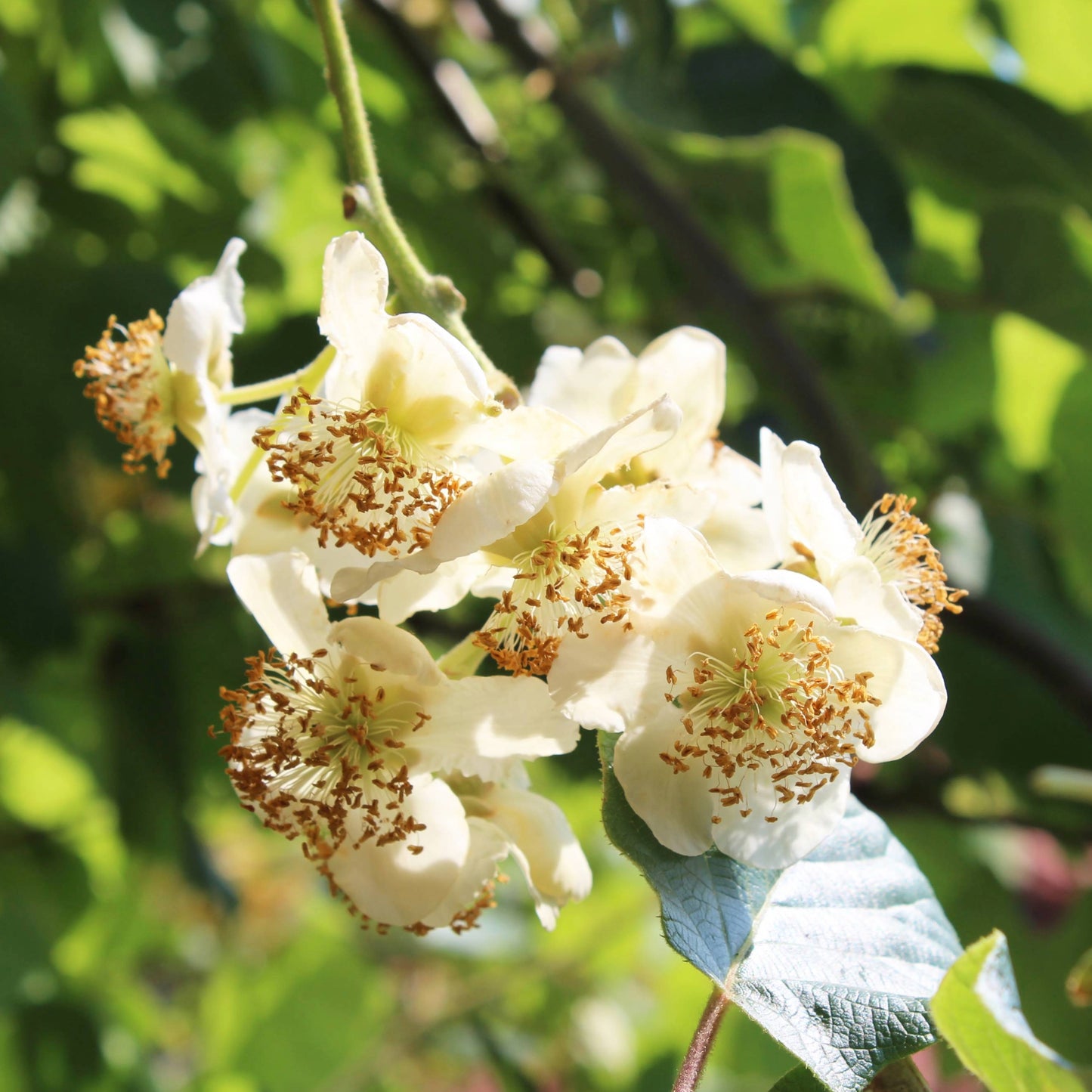
- Fragrant and beautiful white spring blooms
- Fast-growing climbing vine for quick cover
- Dense and highly ornamental summer foliage
Maximize the yield of your vertical orchard with Actinidia arguta 'Meader', an essential and remarkably efficient male pollinator. This vigorous climbing vine deploys dense, attractive foliage that perfectly dresses your structures while ensuring the fruit set of surrounding female varieties. Green up your pergolas or fences with this robust horticultural partner that produces a profusion of subtly fragrant spring blossoms.
Characteristics
- Foliage : Heart-shaped, rich dark green leaves carried on vigorous, twining stems. The foliage is deciduous and generates a natural cooling screen during summer.
- Flowering / Fruit / Canes : Pure white male flowers adorned with dark anthers in June, releasing a pleasant scent that attracts beneficial insects. This variety does not produce any fruit.
- Pollination : Highly efficient male plant. Ensures cross-pollination for 5 to 7 female plants installed nearby. Please note that this variety of *Actinidia arguta* is fully compatible with female cultivars 'Geneva', 'Anna' (syn. 'Ananasnaya'), 'Chung Bai', and 'Issai'. However, it does not pollinate female varieties of *Actinidia kolomikta* (such as 'September Sun' and 'Vitakola').
- Light : Full sun required to stimulate abundant flowering and guarantee pollen viability. Tolerates light partial shade.
- Habit : Climbing and scrambling, requiring a solid, heavy-duty support such as a pergola, a sturdy fence, or a heavy wooden trellis to hold its twining canes.
- Growth : Very fast, developing long, sturdy shoots that wrap themselves around available structures.
- Soil : Thrives in organic-rich, loose, moist, and impeccably drained soil. Dislikes standing water, which causes root rot.
- Temperature : Highly hardy (Zone 4), tolerating cold winters very well. However, its young spring shoots and flower buds in May are sensitive to late frosts.
- Resistance : Excellent natural resistance to common diseases and insect pests.
Use
- Types of use : Ideal for covering a pergola, dressing a large trellis against a sunny wall, furnishing a fence, or planting in a large container near female plants.
- Decorative benefits : Offers quick vertical coverage with an elegant glossy finish, enhanced by the contrast of stems and a fragrant spring blooming essential for garden biodiversity.
Maintenance
- Water : Irrigate regularly during the first two years after planting and maintain uniformly moist soil during summer dry spells to support vegetative growth.
- Fertilize : Apply rich compost or a balanced natural fertilizer in early spring, then fertilize regularly during the growing season to support the vine's vigour.
- Prune : Prune in early spring before the sap rises or right after flowering in July. Cut back cumbersome secondary canes to control volume and maintain access to the support.
- Plant : Set the plant at the base of a sturdy structure, ensuring a maximum distance of 15 to 20 metres from the female varieties to be pollinated to optimize insect work. Add a generous amount of compost to the planting hole. Apply a dormant oil combined with lime sulphur in early spring before the buds break.
- Winter protection : Apply a thick mulch of leaves or straw at the base of the plant for the first two winters to protect the developing root system. Install temporary protection in May if late frosts are forecast.
Plant details
Dimensions
Dimensions
Spacing
244 - 200 cm
Spread
150 - 250 cm
Height
300 - 500 cm
Spacing
96 - 79 in.
Spread
59 - 98 in.
Height
120 - 197 in.
Characteristics
Characteristics
Habit:
- Climbing
Flowering colours:
- White
Plant needs
Plant needs
Watering:
- Especially the first years
- during drought periods
Maintenance:
- Maintenance pruning
- Use mulch to protect from winter
Soil requirement:
- Rich and well drained
Features
Features
Resistance:
- Drought
Attract:
- Pollinators
Use:
- Trellis
Attribute:
- Edible
- Early flowering
- Scented