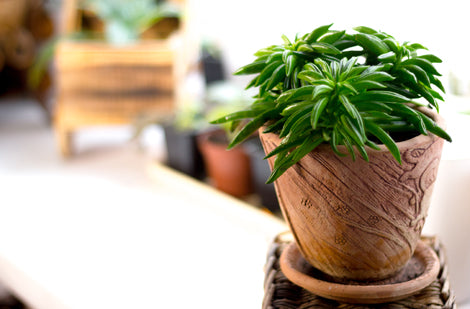
Calathea 'Zebrina'
Calathea 'Zebrina' (Zebra Plant)
Exposure
- Bright Indirect Light
Rusticity
- Unique striped foliage
- Folds leaves at night
- Attractive tropical plant
- Requires high humidity
- Beautiful indoor plant
The Calathea 'Zebrina' is a tropical indoor plant famous for its uniquely striped foliage, giving rise to the common name Zebra Plant. Similar to its popular cousin—the prayer plant—Zebra Plant leaves are bright green with dark green stripes. Foliage colour isn’t the only thing these tropical houseplants have in common, as both plants are known to raise or fold their leaves at night. Calathea 'Zebrina' grows up to 90 cm (3 feet) tall, with leaves reaching up to 60 cm (2 feet) long.
Key Features
- Foliage: Large oval leaves of bright green, adorned with distinctive dark green stripes reminiscent of a zebra's coat. The underside of the leaves is often a purple colour. Interestingly, the leaves have the characteristic of rising and folding vertically at night, a phenomenon called nyctinasty.
- Habit: Grows upright and bushy, forming a beautiful clump of decorative foliage.
- Growth: Considered moderate, the plant may take a few years to reach its mature size indoors.
- Care: Classified as moderate to difficult due to its specific needs for humidity and watering. Consistent attention is required to maintain its optimal appearance.
- Flowering: Flowering is rare as an indoor plant. If it does bloom, it is usually in the spring, producing small purple or white flowers that emerge on spikes. However, it is primarily cultivated for its spectacular foliage.
Care Tips
- Light: Prefers bright, indirect light. Avoid direct sunlight, which can burn the leaves.
- Soil: Requires loamy, moist but well-drained soil. A mix of potting soil, perlite, and peat moss is ideal.
- Watering: Water regularly when the top inch or two of the soil begins to dry. Generally once a week during the growing season and less often in winter.
- Temperature and Humidity: Requires high humidity, ideally above 60%. Warm temperatures between 18°C and 24°C (65°F and 75°F) are preferred. Avoid temperatures below 10°C (50°F). A humidifier, a tray of pebbles with water, or regular misting can help maintain humidity.
- Fertilization: Fertilizing is generally not necessary. If growth is slow, fertilize lightly during the growing season with a balanced formula diluted to a quarter of the recommended strength.
- Propagation: Can be propagated by division in the spring when the plant has produced several rosettes of leaves at the base.
- Repotting: Repot every two years or so, when the plant becomes root-bound. Choose a slightly larger pot with good drainage holes.
Common Problems
- Brown, Curling Leaf Tips: Indicates a lack of humidity or water. Increase humidity and water if the soil is dry.
- Drooping, Mushy Stems: Sign of overwatering. Act quickly to prevent root rot.
Plant details
Dimensions
Dimensions
Characteristics
Characteristics
Habit:
- Upright
- Bushy
Flowering colours:
Plant needs
Plant needs
Watering:
- Tolerates moist soil
Maintenance:
- Average
Soil requirement:
Features
Features
Resistance:
Attract:
Use:
Attribute:
- Slow growth

Related articles
-
-
Kalanchoe: The Secret to Massive Blooms That La...
Read the articleNeed lasting colour? The Kalanchoe blooms profusely for over two months! An easy succulent that tolerates neglect and adds a vibrant touch to your home.
-
Snake Plant: The Unkillable Houseplant, Perfect...
Read the articleLooking for a robust plant that thrives on neglect? Meet the Sansevieria, the champion of clean air! Learn how to care for this striking succulent, explore fascinating varieties like 'Moonshine'...
-
Edible Flowers: Top 5 for Garden and Kitchen
Read the articleOffrant une belle gamme de couleurs, de formes et de textures, les fleurs comestibles enthousiasment les amoureux de jardinage et de cuisine.
-
Tropical Flowering Plants: A touch of the exoti...
Read the articleDreaming of a getaway? Add these spectacular tropical plants to your outdoor decor and enjoy a summer with Southern vibes, right at home!
-
Keep a palm tree on the terrace - why not!
Read the articleIt’s hard to resist the call of the tropics when the sun and mild temperatures finally make an appearance. There is nothing better than a palm tree on the terrace...