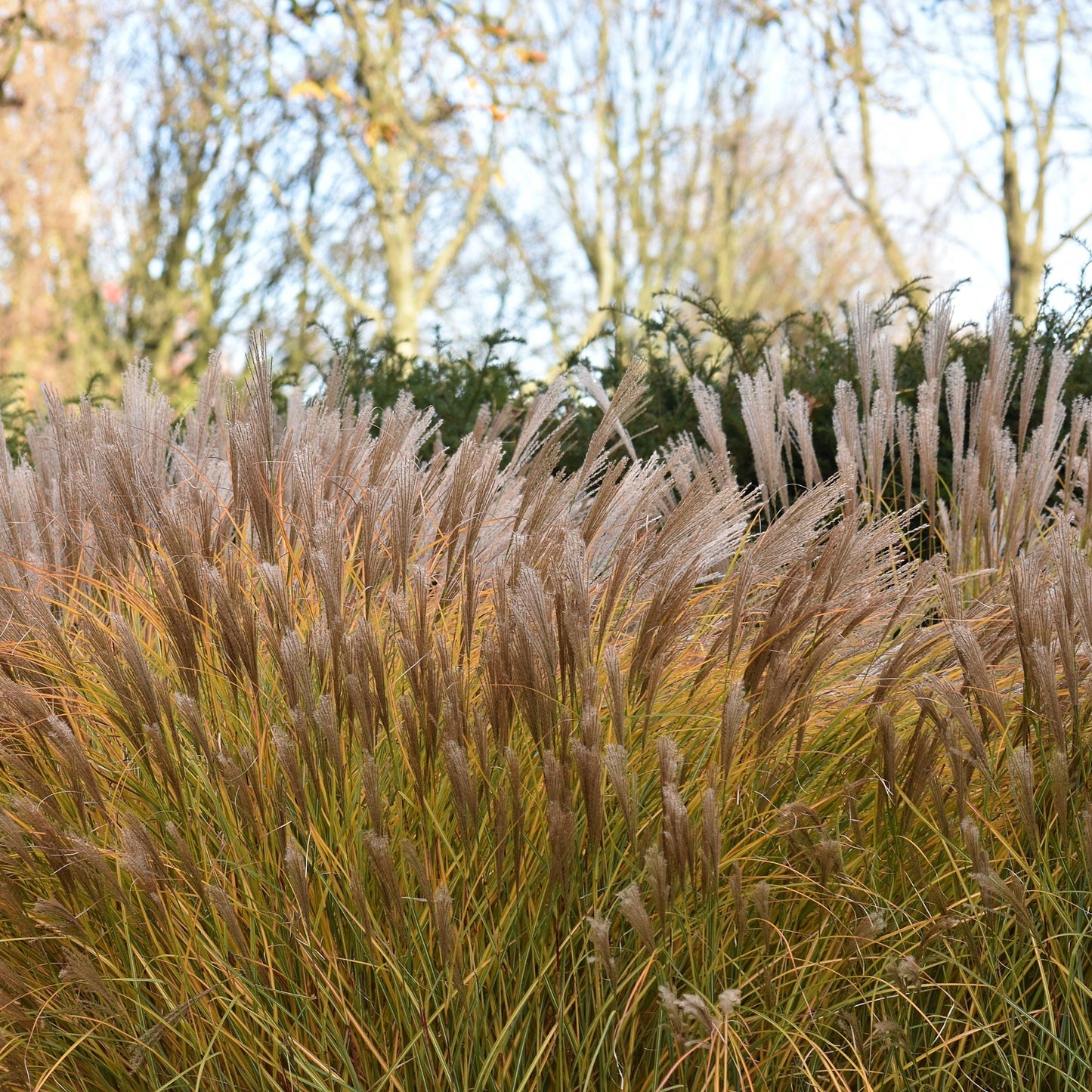
'Malepartus' Miscanthus, a Chinese Silver Grass, is a majestic ornamental grass known for being one of the most spectacular and earliest to bloom. The unique charm of this grass lies in its very large, silky plumes that emerge a coppery-reddish hue in late summer, well before many other varieties. It combines this striking bloom with an ample, graceful habit and colourful fall foliage, making it an essential focal point for the late-season garden.
Characteristics
Foliage: It develops a large clump of wide, deciduous leaves, a rich green with a silvery central midrib during the summer. In the fall, it takes on magnificent warm tones of orange, red, and bronze.
Flowering: Starting in late summer, large, feathery, and silky inflorescences rise well above the foliage. These plumes emerge a rich coppery-red or purple, then open and fade to become silvery as they mature.
Winter Interest: The dried foliage and plumes persist through the winter, offering an imposing architectural silhouette that catches frost and moves with the wind.
Light: It demands full sun for a sturdy habit and abundant flowering.
Habit: It forms a large clump with an upright and gracefully arching habit, creating a majestic fountain-like effect (vase-shaped).
Growth: With a medium growth rate, it reaches a height of 1.8 to 2.4 m (6-8 feet) in bloom, with a spread of 90 to 120 cm (3-4 feet).
Soil: It is a very adaptable plant that tolerates a wide variety of soils, from clay to sand, but prefers soil that remains moist and well-drained.
Hardiness: Very hardy, it faces winters without any problem.
Resistance: This robust grass resists deer well.
Uses
Types of Use: Its imposing size makes it an excellent choice as a standalone specimen, for creating a seasonal privacy screen, or at the back of a large border.
Ornamental Features: It offers a dramatic presence and four-season interest. Its coppery plumes beautifully catch the late-day light, and its fall foliage is spectacular.
Care
Watering: Water regularly during the first season to establish it. Afterwards, it tolerates short periods of drought well.
Fertilizing: No fertilization is necessary.
Pruning: Maintenance is very simple. Cut the dry foliage to the ground in late winter or very early spring, just before new shoots start.
Planting: Plant it in the spring or fall in a sunny location.
Winter Protection: No protection is required for this very hardy grass.
Osez créer des associations inédites qui sauront refléter votre personnalité, même si pour cela vous deviez déplacer certaines vivaces pour mieux les mettre en valeur.
Variétés à découvrir, la tomate se savoure crue, en sandwich, en bruschetta ou en salade. Cuite, c'est l'ingrédient de base de sauces, soupes et salsas.
En pénétrant au jardin, ce sont souvent les plantes vivaces que l’on remarque en premier. Un massif de sauges, d’hémérocalles, d’astilbes, d’échinacées ou de lavande offre un spectacle d’une beauté...